
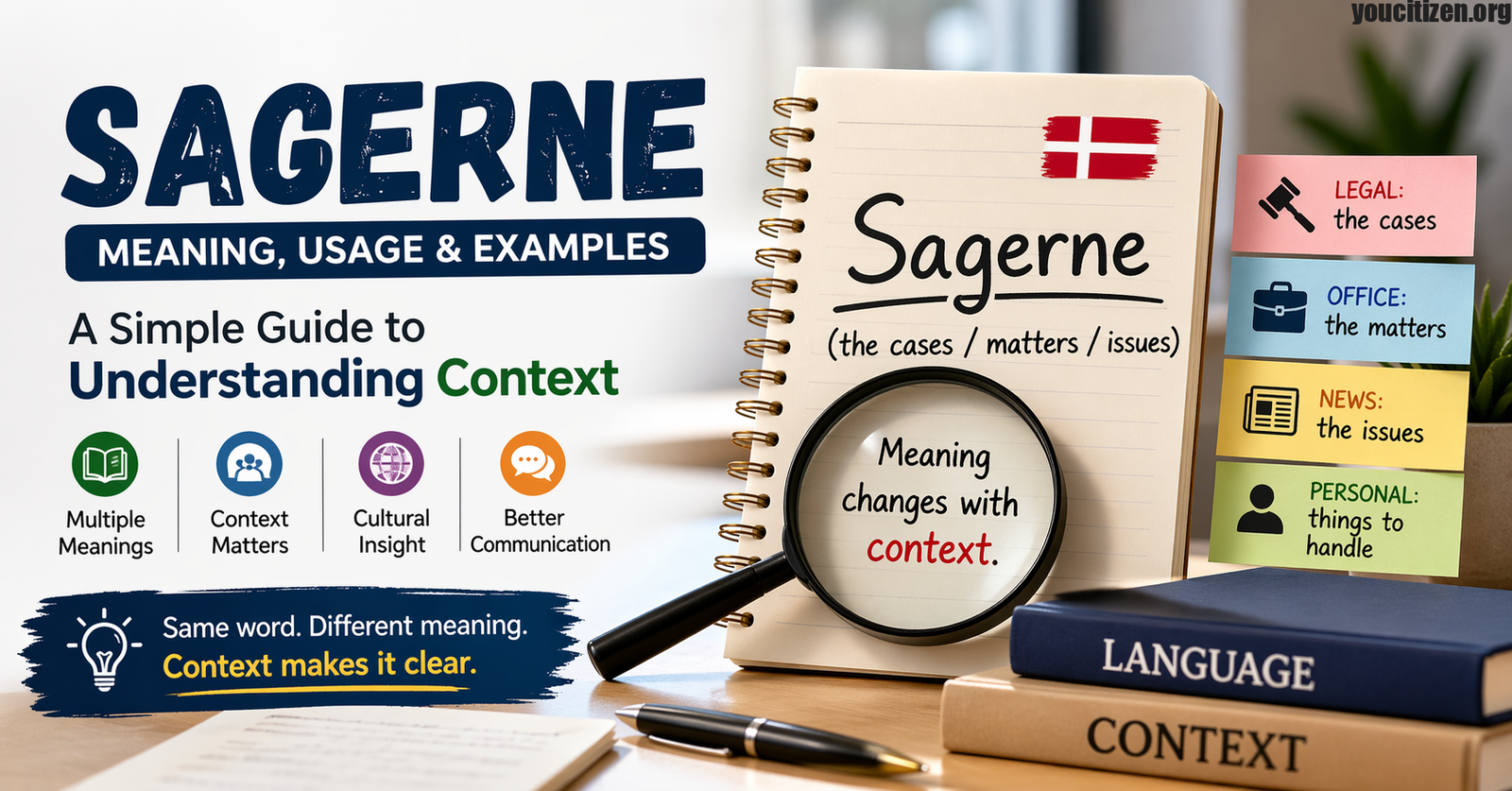
The word sagerne has recently gained attention across the internet, leaving many people curious about its meaning and practical use. At first glance, it may appear complex or unfamiliar, especially to English speakers. Some assume it is a brand, a technical term, or even a concept tied to modern trends. However, the truth is far simpler and far more interesting.
Sagerne is a Danish word that plays an important role in everyday communication legal discussions, and even media narratives. Understanding it not only helps you interpret Danish content more accurately but also improves your overall understanding of how language works across cultures.
What Does Sagerne Mean
At its core, sagerne translates to the cases, the matters, or the issues, but these simple definitions do not fully capture its depth. The most important aspect of the word is its built-in sense of specificity it does not refer to random or undefined topics, but rather to particular matters that are already known within a conversation. In English, the word cases can be vague and general, while the cases clearly points to something identified and shared between speakers.
This distinction is crucial because sagerne always carries that definite meaning. Whenever the term is used, it signals that both the speaker and the listener are aware of the issues being discussed. As a result, the word adds clarity and focus, making communication more precise and efficient by eliminating ambiguity and reinforcing a shared understanding of the subject at hand.
Origin and Linguistic Background of Sagerne
Sagerne comes from the Danish language, which belongs to the North Germanic language family, alongside Norwegian and Swedish. These languages share similar grammatical structures, particularly in how they handle nouns and definiteness.
Word Formation Explained
The word sagerne is built from the root sag, which means a case, matter, issue, or affair. From this base, Danish grammar modifies the word depending on number and definiteness: sag refers to a single case, sager means cases in general, specifically means the cases. Unlike English, which uses separate words like the to show definiteness, Danish often adds endings directly to the noun itself. In this case, the suffix -ne indicates that the word is both plural and definite. This structure is a key feature of Danish, making words more compact while still carrying precise meaning within a single term.
Why Sagerne Means The Cases and Not Just Cases
One of the most common misunderstandings about sagerne is assuming it functions as a general plural noun, when in fact it is always a definite plural form. This means it refers to specific, already identified matters rather than vague or unknown ones.
For example, in English, saying we are reviewing cases suggests a general or undefined group, while we are reviewing the cases clearly points to particular cases that both the speaker and listener recognise. In the same way, always carries the meaning of the cases within a known context. This small grammatical distinction is crucial, as it shapes the clarity and precision of communication and ensures that the word is used correctly in both formal and everyday situations.
How Sagerne Is Used in Real Life Contexts
One of the reasons sagerne is so widely used is its flexibility. It can appear in multiple contexts while maintaining its core meaning.
Legal and Administrative Contexts
In legal and administrative settings,is commonly used to refer to formal matters such as court cases, legal files, investigations, and other official proceedings. For example, a sentence like “Sagerne are under review by the court” clearly points to specific cases that are already identified within the legal system. In this context, the word carries a serious and structured tone, often linked to processes that involve rules, documentation, and decision-making. Its use ensures clarity when dealing with multiple cases that require professional attention.
Workplace and Professional Use
In offices and professional environments, sagerne takes on a more practical meaning, often referring to tasks, projects, documents, or general work-related matters. For instance, when someone says, We need to complete before the deadline, they are talking about specific tasks that are already known within the team. In this setting, the word becomes more action-oriented and helps streamline communication by grouping multiple responsibilities under one clear term.
Media and Journalism
Within media and journalism, used to describe public issues, controversies, or ongoing developments that are being reported in the news. Journalists often rely on the term to group several related stories together, making complex or evolving situations easier for audiences to follow. By using sagerne, reporters can maintain a sense of structure and continuity, especially when covering multiple events that are connected within a broader narrative.
Everyday Conversations
In everyday conversations, sagerne is used in a more relaxed and informal way to refer to responsibilities, personal matters, or things that need attention. For example, someone might say, I will take care of this week, indicating they have a set of known tasks or issues to handle. This usage shows how flexible the word is, as it adapts easily to casual contexts while still maintaining its core meaning of referring to specific, recognised matters.
Cultural and Historical Context Behind Sagerne
The word sagerne also carries deeper cultural roots that connect it to Scandinavian history and storytelling traditions. Its root word “sag” is closely linked to the idea of a “saga,” which refers to the rich narrative traditions of Old Norse culture, where stories were used to preserve history, values, and human experiences.
This connection is important because it suggests that cases and matters are not viewed only as isolated facts, but as part of a broader narrative shaped by people and events. From this perspective, each “case” can be seen as a story with context, development, and meaning. This cultural background adds an extra layer of depth to sagerne, transforming it from a simple grammatical term into a word that reflects how Scandinavian culture understands life as interconnected stories rather than separate, unrelated incidents.
Modern Interpretations of Sagerne
In modern digital content, sagerne is sometimes used in a broader and more conceptual way beyond its traditional linguistic meaning. Instead of referring only to specific “cases” or matters, some writers reinterpret it to represent ideas such as problem-solving, organisatio, and decision-making.
Although these interpretations are not strictly part of the original Danish grammar, they show how language can evolve and adapt in digital spaces. This modern usage reflects the flexibility of words online, where meanings often expand creatively depending on context and the writer’s intent.
Why Sagerne Is Gaining Popularity Online
- Many non-Danish speakers search for sagerne because it looks unfamiliar and sparks curiosity.
- The word has multiple possible meanings such as “cases,” “matters,” or “issues,” which creates confusion and interest.
- It often appears in subtitles, translations, and online content, leading viewers to look up its meaning.
- Its unique spelling, sound, and structure make it stand out and easy to remember.
- It is commonly encountered in legal, media, or administrative translations, where context is not always clear to readers.
- People are increasingly exposed to Danish terms through global streaming platforms and international content.
- The lack of a single direct English equivalent encourages users to search for detailed explanations.
- Online articles and SEO content about the word have further increased its visibility and search volume.
Common Mistakes People Make About Sagerne
- Mistaking sagerne for a brand name or company.
- Assuming it is only used in legal contexts.
- Translating it the same way in every situation without checking context.
- Ignoring the surrounding sentence or situation where it appears.
- The most important mistake is not considering context, which can completely change the meaning.
Why Context Is More Important Than Direct Translation
Words like sagerne cannot be translated accurately without understanding the context in which they are used. A direct, word-for-word translation often leads to confusion because the meaning changes depending on the situation. The correct approach is not to ask “What does sagerne mean? in isolation, but instead to first understand what is being discussed in the sentence or conversation.
Once the context is clear, the meaning becomes much easier to interpret. For example, in a legal setting it may refer to the cases, in a workplace it can mean the matters, and in casual conversation it may simply refer to “the issues” or things that need attention. This context-based method ensures a more accurate and natural understanding of the word in real-life usage.
Practical Tips to Understand Sagerne Easily
- Learn the basic pattern: sag → sager → sagerne to understand how the word changes.
- Always focus on context by reading the full sentence before translating.
- Practice with real-life examples to improve natural understanding and usage.
- Avoid literal, word-for-word translation and instead focus on the overall meaning in context.
Real Life Examples of Sagerne
Let’s look at how sagerne works in different scenarios to understand its flexibility in real usage. A legal context, the sentence The authorities are reviewing refers to official cases or investigations being examined by the relevant authorities.office environment, We must complete today points to specific tasks, documents, or work-related matters that need to be finished within a deadline. In news reporting, are receiving public attention highlights ongoing issues or stories that are currently being discussed or followed by the public. In personal life,
I will handle sagerne this weekend refers to private responsibilities, errands, or matters that need attention. In each of these examples, the core meaning remains the same, but the context changes how the word is applied, showing its adaptability across different situations.
Why Sagerne Matters in Language and Communication
Sagerne is a great example of how language can combine multiple meanings into a single word while still relying heavily on context for clarity. It shows that meaning is not always fixed but can shift depending on how and where the word is used. This flexibility also reflects deeper cultural thinking, where language is shaped by the way people organise and understand their experiences.
By studying words like sagerne, learners can improve their translation skills, communicate more accurately, and develop stronger cross-cultural awareness. It highlights how understanding context is essential for interpreting meaning correctly in any language.
Conclusion
The word sagerne may seem unfamiliar at first, but it is actually simple and logical once you understand its structure and usage. It generally means the cases, the matters, or the issues, depending on context.
By focusing on context, grammar, and real-life usage, you can confidently understand and use sagerne in any setting. In a world where languages constantly interact, words like this remind us that communication is not just about translation it is about understanding.
FAQs
What does sagerne mean in English?
It means the cases, the matters, or the issues, depending on context.
Is sagerne only used in legal situations?
No, it is used in legal, workplace, and everyday conversations.
Why is sagerne confusing?
Because it has multiple meanings and depends on context.
How can I understand sagerne correctly?
Always look at the full sentence and identify the topic.
Disclaimer
This article is for informational purposes only and is not a professional language guide. The explanations are based on general understanding and context. The author is not responsible for any errors, misinterpretations, or any loss or damage arising from the use of this information.