
In the modern digital era, technology is no longer just about isolated tools or standalone software. Today, success depends on how well systems communicate, share data, and respond in real time. This is where Sinkom comes into focus.
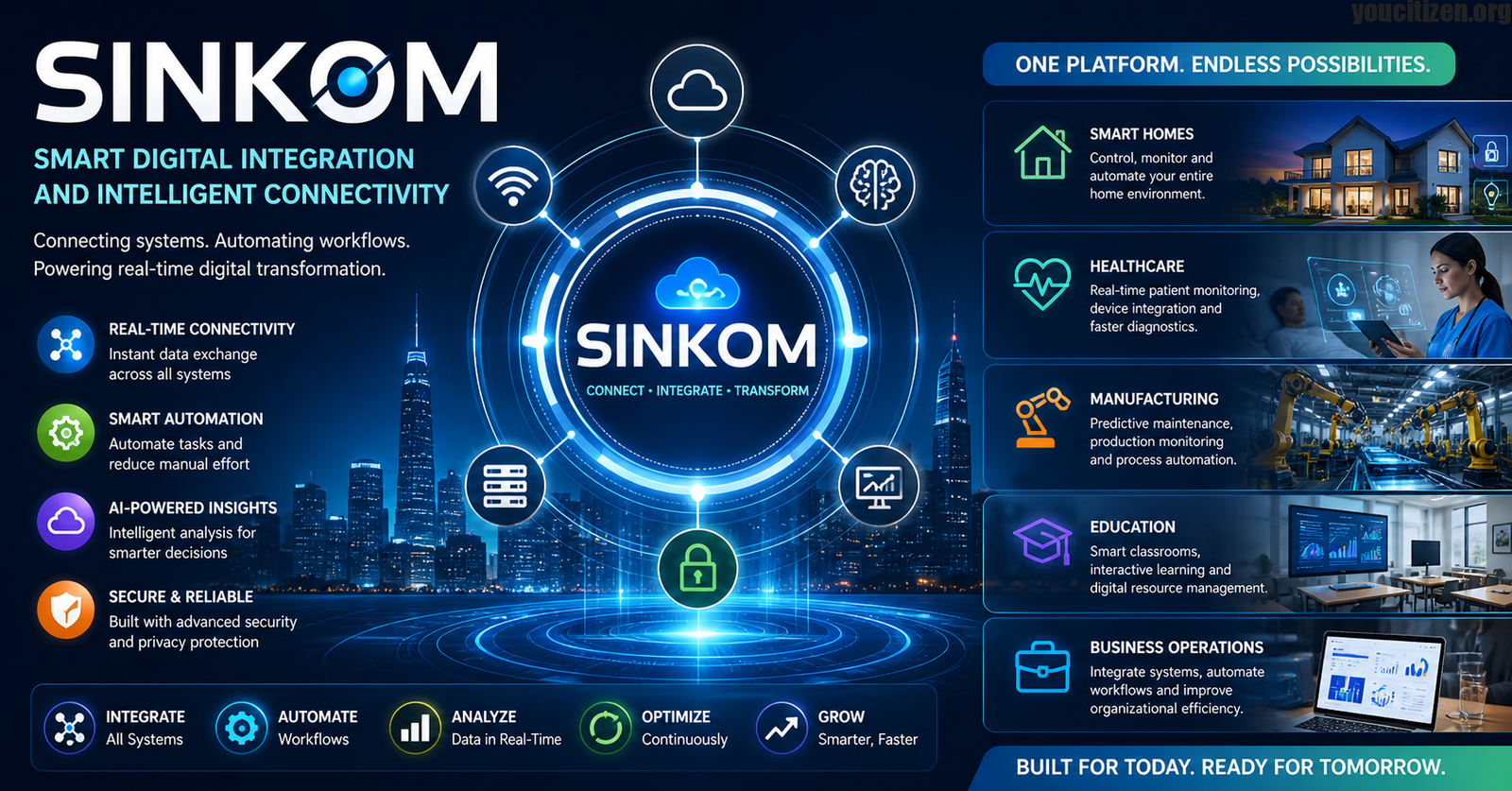
Sinkom is a modern concept of intelligent system integration, designed to connect devices, platforms, and processes into a unified ecosystem. Instead of operating separately, systems under work together in harmony, allowing real-time communication, automation, and decision-making.In simple terms,represents the evolution from disconnected technology to fully synchronised smart environments.From smart homes and healthcare systems to large-scale industrial operations, becoming a powerful backbone for digital transformation.
Origin and Background of Sinkom
The concept of Sinkom emerged from the need for better system synchronisation in complex digital environments. As industries adopted cloud computing, IoT, and AI tools, a major issue appeared systems were not properly connected, leading to inefficiency and delays.
To solve this, engineers explored ways to reduce fragmentation. Sinkom evolved as a response to problems like poor communication between systems, inefficient data sharing, delayed processing, and the growing demand for real-time decision-making.Instead of replacing existing systems, focuses on connecting them into a unified network. It is not tied to any single company or product, but serves as a flexible framework for integrating digital technologies across industries.
Core Technology Behind Sinkom
Sinkom operates on a combination of three major technological pillars Artificial Intelligence (AI), Internet of Things (IoT), and cloud computing. AI enables the system to analyse data, recognise patterns, and make intelligent decisions without human intervention.
IoT devices act as data collectors, continuously gathering and sending real-time information from sensors, machines, and smart devices into the system. Cloud computing then stores, processes, and distributes this large volume of data across connected platforms. Together, these technologies form a self-learning and adaptive ecosystem where devices and systems communicate seamlessly and continuously improve overall performance.
Sinkom Works Step by Step Breakdown
| Step | Process | Description |
| 1 | Data Collection | Sensors, applications, and devices collect real-time data from the environment. |
| 2 | Data Transmission | The collected data is sent to a central Sinkom system or cloud-based network. |
| 3 | Data Analysis | AI algorithms process the data to identify trends, issues, or opportunities. |
| 4 | Decision Making | The system selects the most efficient action based on analysis. |
| 5 | Execution | Automated commands are carried out across connected devices. |
| 6 | Feedback Loop | The system learns from outcomes and improves future decisions continuously. |
Key Features of Sinkom Technology
Sinkom stands out due to its advanced and flexible design, offering a range of powerful features that make it suitable for modern digital environments. One of its key features is real-time communication, which allows all connected systems to exchange data instantly without delays. It also supports automation, reducing human workload by handling repetitive tasks automatically.
Another important feature is scalability, meaning Sinkom can operate efficiently in both small environments like smart homes and large-scale enterprise systems. Its modular architecture allows systems to be expanded or modified without disrupting the entire network. Additionally, cross-platform integration ensures compatibility with multiple devices and software systems, regardless of brand or underlying technology, making highly adaptable and efficient.
Applications of Sinkom Across Industries
Sinkom is not limited to a single field; its flexibility makes it valuable across multiple industries. The smart homes, it allows users to control lighting, security, temperature, and appliances through a unified system. In healthcare, hospitals use to monitor patients in real time, manage medical devices, and improve diagnosis speed and accuracy.
The manufacturing, it supports predictive maintenance, production monitoring, and automation of assembly lines, helping improve efficiency and reduce downtime. In education, Sinkom enables smart classrooms with interactive learning tools and efficient digital resource management. In business operations, companies use it to integrate CRM systems, automate workflows, and enhance communication across departments, resulting in smoother and more efficient operations.
Benefits of Sinkom Technology
- Increased Efficiency Automation reduces manual effort and speeds up operations.
- Cost Reduction Optimised workflows help minimise waste and lower resource usage.
- Real-Time Insights Instant data analysis supports faster and better decision-making.
- Improved Connectivity Different systems and devices work together seamlessly.
- Enhanced Productivity Employees can focus on strategic tasks instead of repetitive work.
Sinkom in Business Environments
For modern businesses, Sinkom is more than just a tool it is a complete digital transformation strategy. It supports startups by offering a scalable structure that allows growth without heavy infrastructure costs, while large enterprises use it to unify complex systems across departments and global operations.
Through system integration, connects existing tools such as ERP, CRM, and analytics platforms into a single ecosystem, reducing fragmentation and significantly improving overall operational visibility and efficiency. This leads to faster decision-making and smoother workflows across teams. Ultimately, helps organisations stay competitive by enabling smarter, more connected, and data-driven operations.
Security and Privacy in Sinkom Systems
As digital systems become more connected, security becomes a top priority, and Sinkom addresses this through multiple advanced protection layers. It uses end-to-end encryption to secure data during transfer, ensuring that information cannot be accessed by unauthorized parties. A zero-trust security model is also implemented, meaning every request is verified before access is granted, regardless of its source.
In addition, continuous system monitoring helps detect and prevent suspicious activity in real time. Secure authentication protocols further strengthen protection by ensuring only verified users and devices can access the system. Together, these features ensure that sensitive data remains fully protected at all times.
Challenges of Sinkom Implementation
Despite its advantages, Sinkom also faces several challenges that can affect its adoption. One of the main issues is high initial setup costs, as advanced infrastructure and modern systems may require significant investment. Technical complexity is another concern, since integrating Sinkom with older or legacy systems can be difficult and time-consuming. In addition, skill requirements play an important role because proper training is needed to effectively manage and operate environments.
Limited awareness also slows down adoption, as many organisations are still unfamiliar with its full potential and benefits. However, these challenges are gradually decreasing as technology becomes more accessible and easier to implement over time.
Future of Sinkom Technology
- AI Advancements Sinkom will evolve with more powerful artificial intelligence for smarter automation and decision-making.
- 5G & 6G Networks Faster and more reliable connectivity will enhance real-time data communication.
- Edge Computing Growth Local data processing will reduce latency and improve system performance.
- Blockchain Security Future systems may use blockchain for stronger transparency and data protection.
- Smart Cities Fully autonomous smart cities will be powered by Sinkom-based infrastructure.
- Predictive Automation Systems will anticipate needs and act before problems occur.
- Industrial Self-Optimisation Factories and networks will automatically adjust for maximum efficiency.
- Global Connectivity Real-time worldwide system integration will become more seamless and stable.
Why Sinkom Matters Today
Sinkom is important because it solves one of the biggest challenges in modern technology system fragmentation.
In a world where businesses and users rely on multiple platforms, Sinkom creates order, efficiency, and intelligence by connecting everything into one ecosystem.It transforms technology from being reactive to being proactive and adaptive.
Conclusion
Sinkom represents a powerful shift in how digital systems operate. By combining AI, IoT, and cloud technologies, it enables real-time communication, automation, and intelligent decision-making across industries.
From smart homes to global enterprises,shaping a future where systems are no longer isolated but deeply connected and self-learning.As digital transformation continues to accelerate, Sinkom is positioned to become a key driver of next-generation smart technology ecosystems.